


Intersectionality
Not a description of identity. A description of how systems fail.
Intersectionality has been used so loosely for so long that it has started to mean nothing more than "we thought about diversity". That is a shame, because the original idea is sharp, specific, and useful — and it was built to solve exactly the kind of problem our clients keep running into.
Where the idea comes from
The term was coined by the legal scholar Kimberlé Crenshaw in 1989. She was looking at anti-discrimination law in the United States and at a particular kind of case that kept failing.
Black women were bringing claims and losing. Not because the discrimination had not happened, but because the law could only hear one claim at a time. Asked to consider race, the court looked at how the employer treated Black men and found no race problem. Asked to consider sex, it looked at how the employer treated white women and found no sex problem. Neither question described what had actually happened to the claimant, which was a thing that only happened to Black women and was therefore invisible to a system that examined one axis at a time.
Crenshaw's point was structural rather than personal. The harm was not simply the sum of racism plus sexism. It was its own thing, produced at the place where the two met, and it could not be seen from either road on its own.
Intersectionality is not a description of identity. It is a description of how systems fail.
Why it still matters here
Aotearoa has its own version of the same problem, and it shows up in whichever system you happen to be standing in.
A disabled Māori person meets a disability system that was not designed with te ao Māori in it, and a Māori health system that was not designed with disability in it. Each can do its job perfectly well and still leave that person unserved, because the gap is between them rather than inside either one.
A takatāpui young person in a rural town has rainbow services in a city they cannot afford to reach, and local services that have never had to think about them. A trans person who is pregnant meets maternity care built around an assumption so basic that nobody wrote it down.
In each case, every individual service can point at its own records and say, accurately, that it is doing fine.
What it is not
Three things get called intersectionality that are not it.
Listing identities
Naming more groups in a strategy document does not make it intersectional. If each group gets its own paragraph and its own workstream, the structure is still single-axis — it just has more axes. The question is what happens to the people who belong to two of them at once, and whether anyone owns that.
Counting people
Representation data is useful and it is not the same thing. You can have proportionate numbers in every category and still have an organisation where nobody at the intersections can get anything done.
A statement of values
A commitment to intersectionality that changes no process, no delegation, no budget line and no decision is a commitment to the word.
The test we use. Pick the person your systems serve least well, and find out whether anyone in the organisation is accountable for their outcome. Not consulted about it — accountable for it. If the answer is no, the strategy is single-axis however many groups it lists.
How we work with it
Intersectionality is the core of the practice rather than a service line within it. It shows up as a set of working habits.
- We start at the margins, not the median. A service designed for the person it currently fails worst tends to work better for everyone. A service designed for the average user tends to fail the same people it already failed.
- If it is about us, include us. Not as consultees at the end, but as the people making the decision.
- We name the constraints. Budgets, legislation, workforce, timeframes. Designing inside reality produces change; designing outside it produces a report.
- We bring te ao Māori as standard. Tikanga, te reo and whakataukī are part of how the work is done, not an add-on offered to clients who ask.
- We are the communities we work with. Māori, Pacific, tāngata whaikaha, takatāpui. That is not a credential; it is the reason we notice the gaps between systems without having to go looking.
Reference: Kimberlé Crenshaw, "Demarginalizing the Intersection of Race and Sex", University of Chicago Legal Forum, 1989.
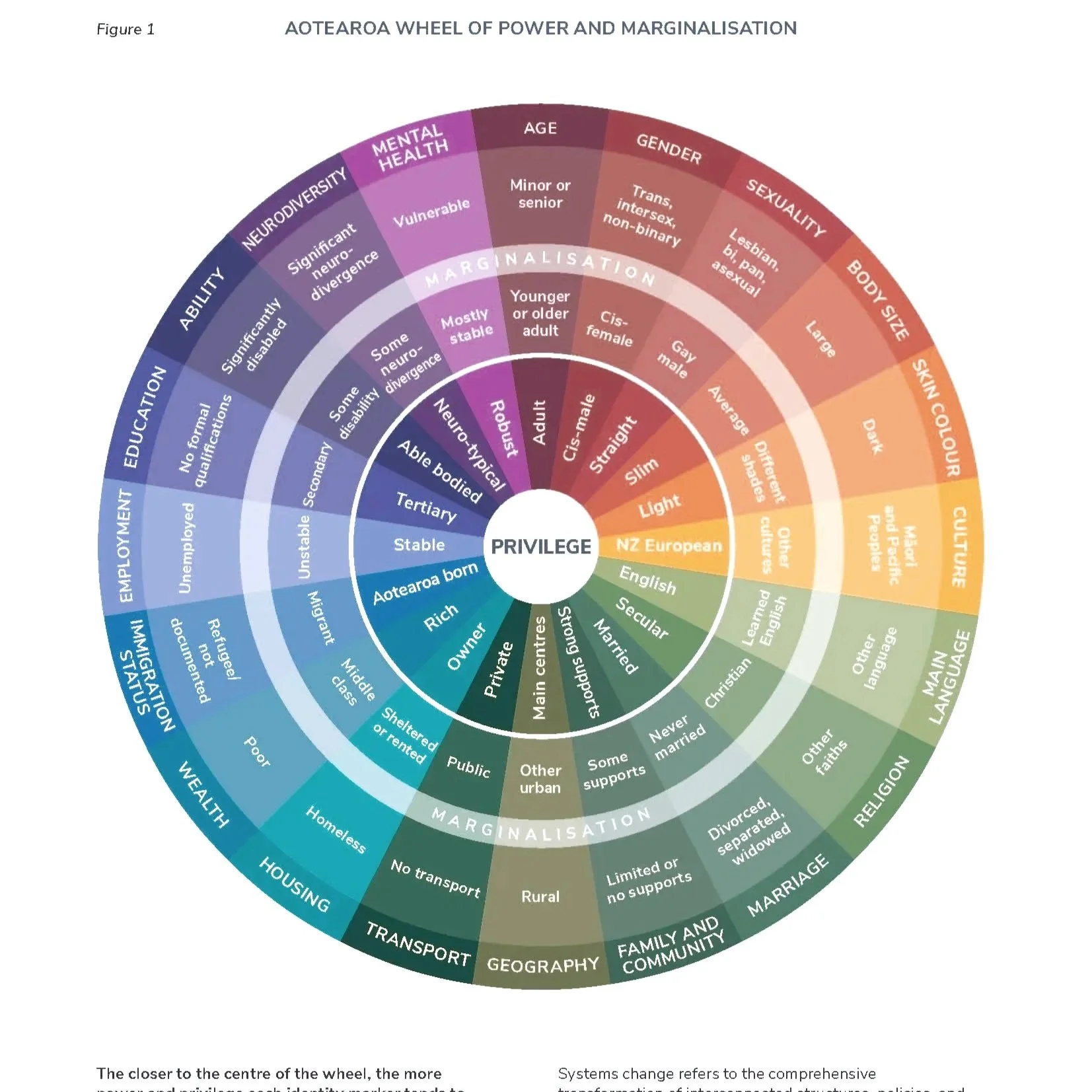
One person, every ring at once
Nobody sits in a single spoke. Everyone is somewhere on all of them at once, and it is the combination that decides what they meet. Read the wheel across rather than down: the closer to the centre, the more the systems around you were built with someone like you in mind.